
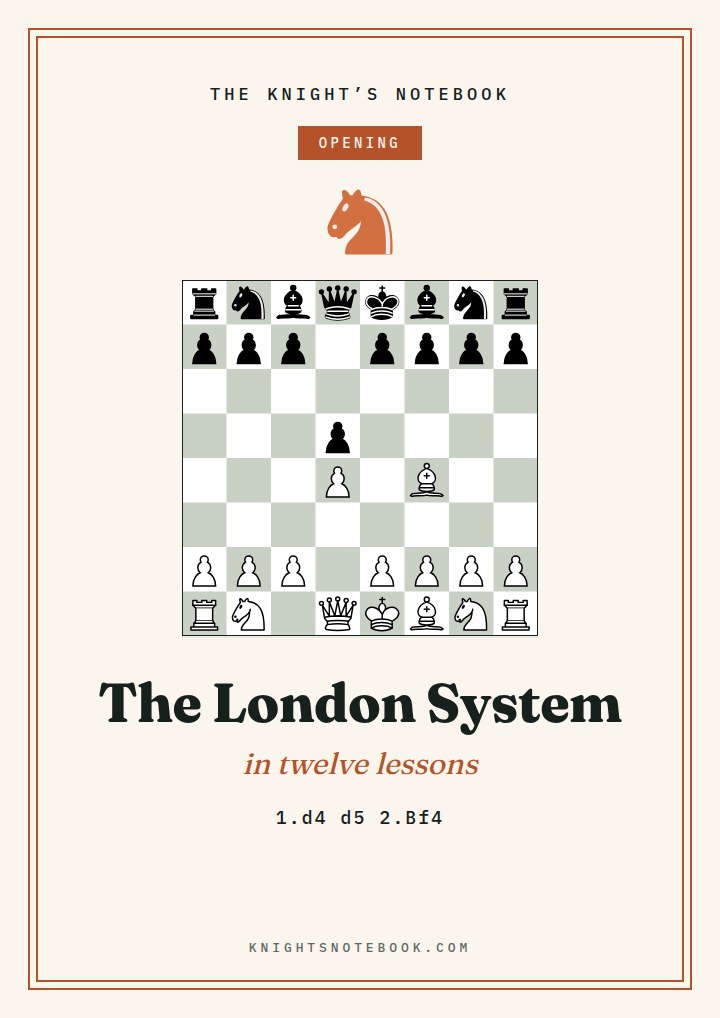
The London Systemin twelve lessons.
1.d4 d5 2.Bf4
A course to play the London System with White, written for club players: one setup against 1…d5, 1…Nf6 and the rest, the plans that go with it, the attack on the king and the traps. Each lesson gives you the moves, the plans of both sides, a model game and the trap to know, then two exercises from real games played in that line.
One payment, on Stripe’s secure page: card, Apple Pay, Google Pay or PayPal. The PDF is emailed to you right after payment.
- A4 PDF to print, 66 pages
- Twelve lessons, thirty exercises
- Every solution explained
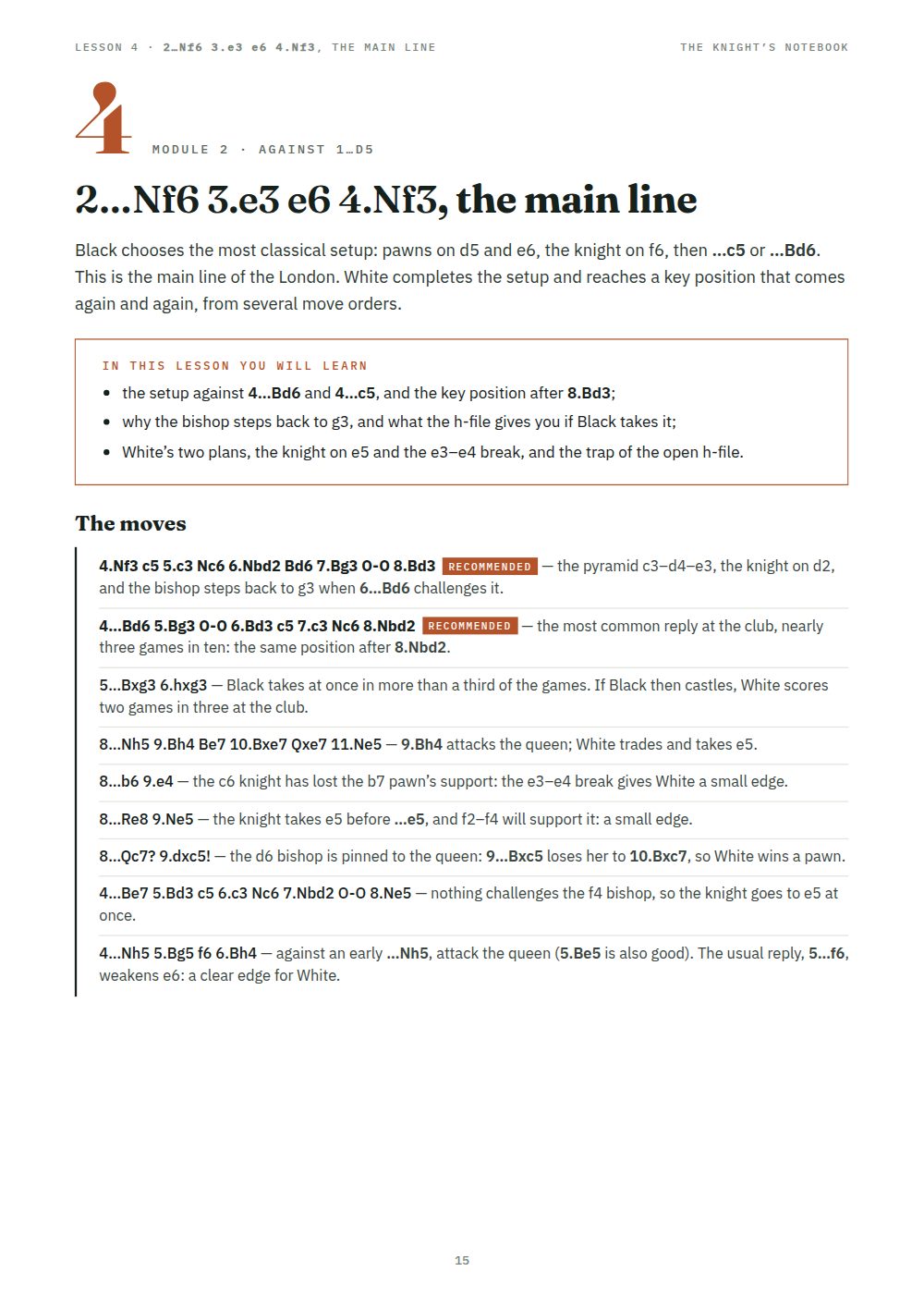
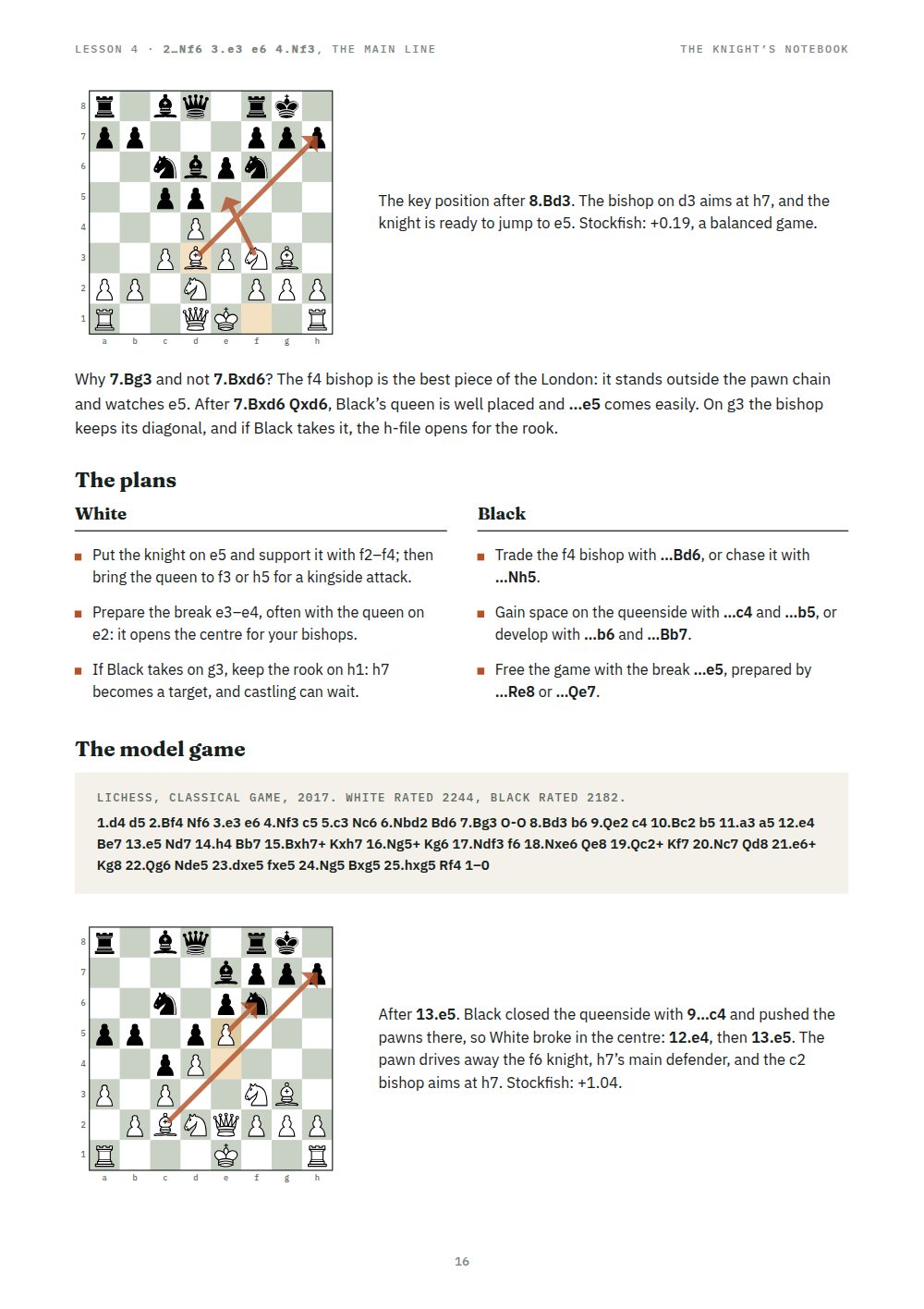
Every lesson, the same six steps.
The moves
The line this book recommends, in bold, and the alternatives, each with one sentence on what it changes.
The plans
What White aims for and what Black aims for: the squares, the pawn breaks, the pieces to trade.
A model game
A real Lichess game in that line, with its turning points on diagrams.
The trap
The bait, the refutation, and how not to fall for it yourself.
Remember
Three to five sentences that sum up the lesson.
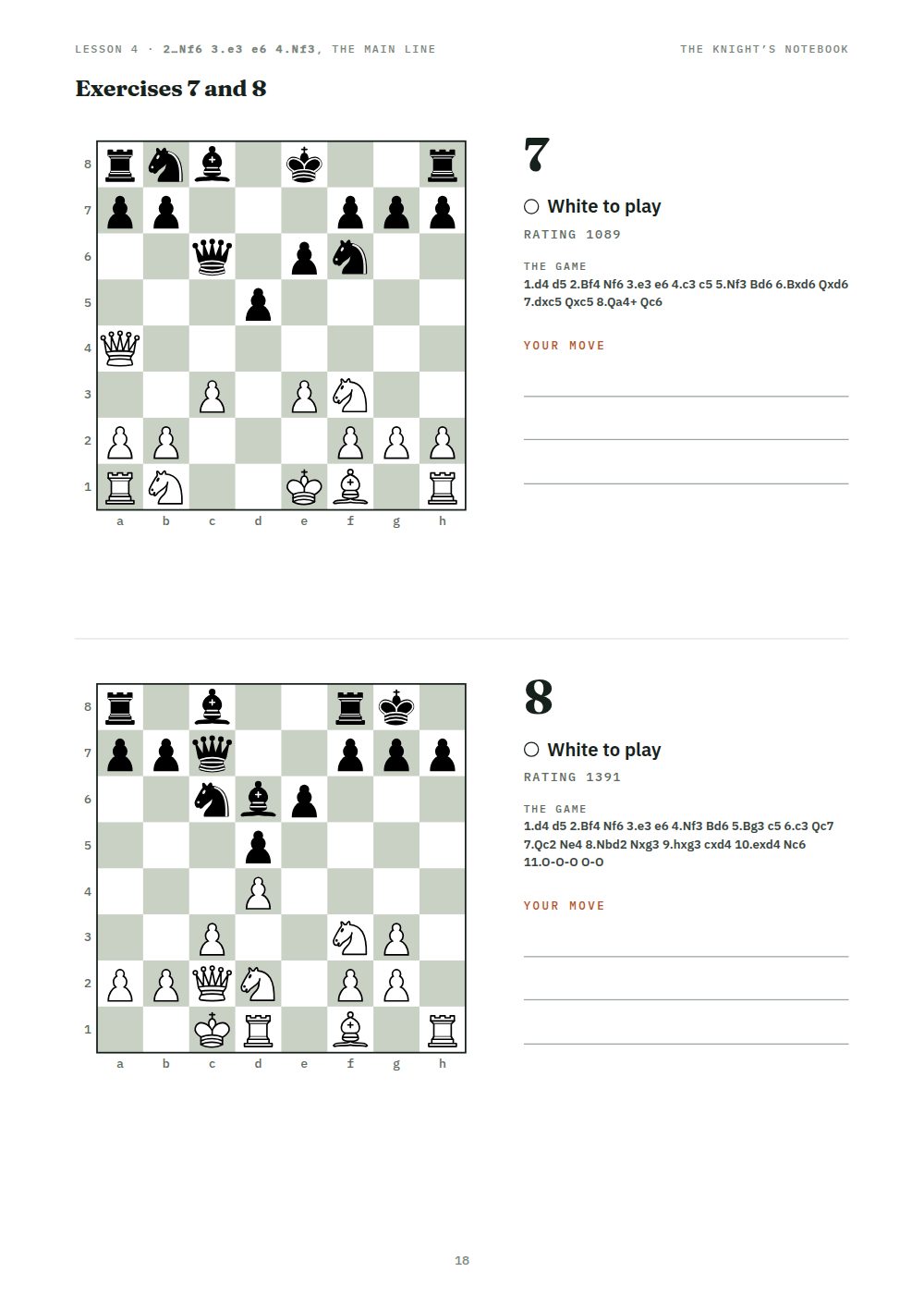
Two exercises
Positions from real games played in that line, with the solutions explained at the back.
Lessons 1 to 3 lay the foundations, lesson 11 gathers the attack and lesson 12 ten traps, so they follow their own plan.
Pages from the book.
Four modules, twelve lessons.
Module 1Foundations
- 01Why the London
- 02The first moves and Black’s replies
- 03The five motifs of the London
Module 2Against 1…d5
- 042…Nf6 3.e3 e6 4.Nf3, the main line
- 05…c5 and the queen on b6
- 062…Nc6, the most common club reply
- 07…Bf5 and …Bg4: Black’s bishop comes out early
- 08The early …Bd6, 2…c6 and the rarer replies
Module 3Against 1…Nf6
- 092…g6 and 2…d6: the King’s Indian setup
- 102…e6, 2…c5 and the other replies
Module 4The attack and the traps
- 11The attack on the king
- 12Ten traps to know
- Final examsix positions from real games, without the name of the line
- Solutionsevery exercise explained, with the tempting move that fails
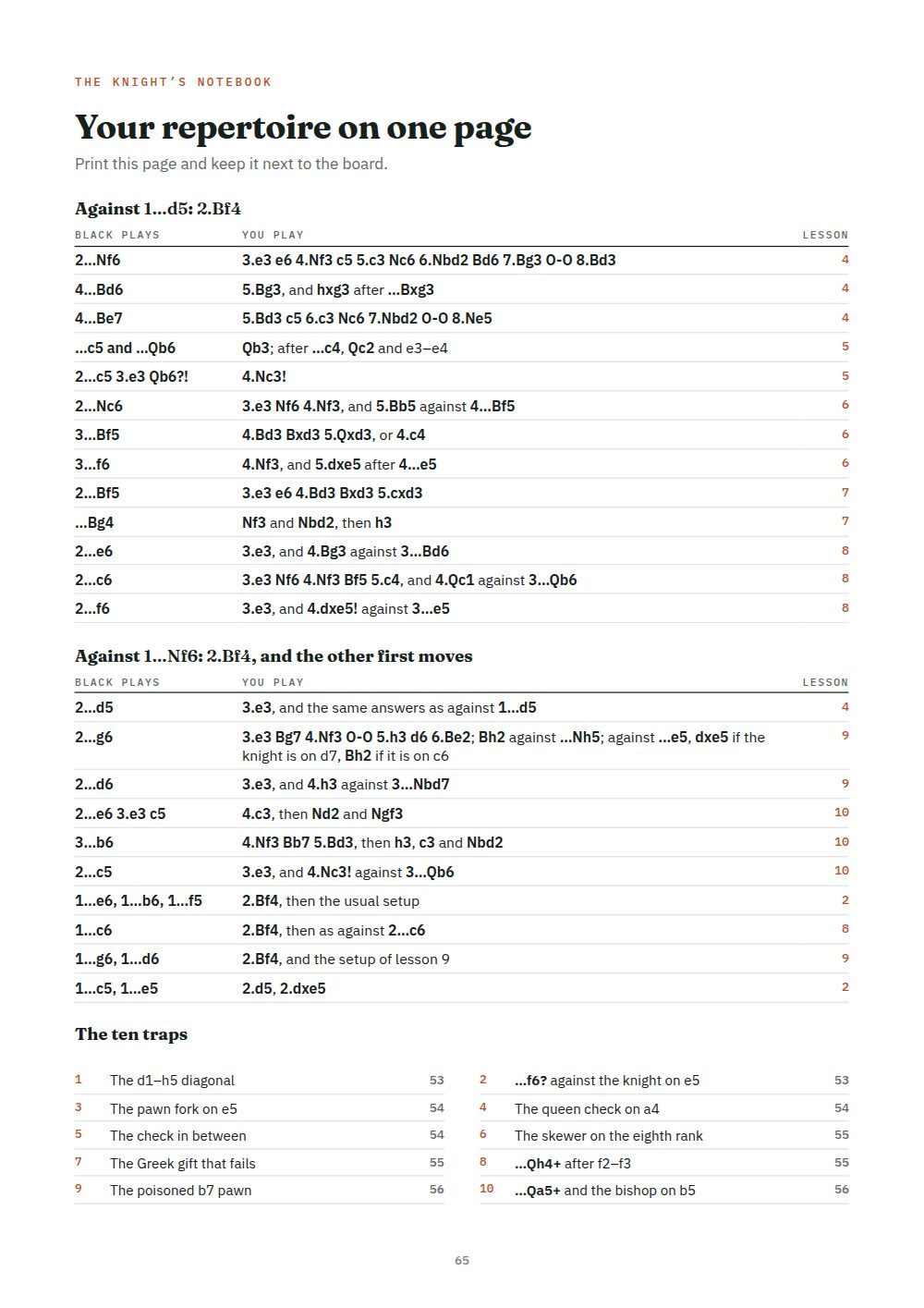
- Your repertoire on one pagethe moves to play against each reply, and the ten traps
What Black plays at the club.
Black’s replies to 1.d4 and 2.Bf4, how often each was played in 137,788 club games on Lichess, and the lesson that deals with it.
After 1.d4
| 1…d5 | 57 % | the main move: see below |
| 1…Nf6 | 15 % | see below |
| 1…e6 | 11 % | lesson 2 |
| 1…g6 | 4 % | lesson 9 |
| 1…d6 | 3 % | lesson 9 |
| 1…c6 | 2 % | lesson 8 |
| 1…f5 | 2 % | lesson 2 |
| 1…b6 | 2 % | lesson 2 |
| 1…c5and the rarer moves | 1 % | lesson 2 |
After 1.d4 d5 2.Bf4
| 2…Nc6 | 28 % | lesson 6 |
| 2…Nf6 | 23 % | lesson 4 |
| 2…e6 | 21 % | lesson 8 |
| 2…Bf5 | 11 % | lesson 7 |
| 2…c6 | 4 % | lesson 8 |
| 2…c5 | 4 % | lesson 5 |
| 2…f6and the rarer moves | 2 % | lesson 8 |
After 1.d4 Nf6 2.Bf4
| 2…e6 | 26 % | lesson 10 |
| 2…g6 | 24 % | lesson 9 |
| 2…d5 | 21 % | lesson 4 |
| 2…d6 | 16 % | lesson 9 |
| 2…c5 | 5 % | lesson 10 |
| 2…Nc6and the rarer moves | 4 % | lesson 10 |
Club players who play 1.d4.
- Club players from about 1000 to 1800 Elo who play 1.d4 and want one setup that works against everything.
- You only need the rules and basic tactics: the forks, pins and attacks on h7 of the London are explained in lesson 3.
- If you meet the London with Black, the book explains Black’s plans in every lesson too.
Your questions, answered.
Is it right for my level?
Yes, if you are a club player from about 1000 to 1800 Elo who opens with 1.d4. You only need the rules and basic tactics: the forks, pins and attacks on h7 of the London are explained in lesson 3. And if you meet the London with Black, every lesson explains Black’s plans too.
What does each lesson give me?
Everything you need to play the line with confidence: the moves, the plans of both sides, a model game with its turning points, the trap to know and a short summary to remember, then two exercises from real games played in that line.
How are the solutions explained?
Every exercise is explained at the back of the book, with the tempting move that fails. And a final exam of six positions from real games, without the name of the line, shows you what you have really taken in.
Can I print it more than once?
As often as you like: the pages are A4, ready to print, and on US Letter paper you choose “Fit to page”. Keep the page with your repertoire next to the board.
When will I get it?
Right away. The moment you pay, an email brings you the download link, usually within a few minutes, and it keeps working whenever you want to download the book again. Anything wrong? Check your spam folder or write to us at hello@knightsnotebook.com: we will send it again.
Is payment secure?
Yes. You pay by card or Apple Pay through Stripe, one of the most widely used payment platforms in the world, and other options may be offered depending on your country. We never see your card details. It is a single payment, with no subscription.
How is it different from the monthly notebook?
This book teaches you one opening in depth, from the first move to the traps, with your repertoire on one page: to keep and look over before every tournament. The monthly notebook is your regular tactics training: every month, sixty new positions at your level. The two go together.
Where do the games and the exercises come from?
From real games played on Lichess, where all games are public: you learn what is actually played at the club. The players are not named; the book gives their ratings, the time control and the year. Every line was checked with Stockfish 19.
Which notation does it use?
Algebraic notation with the English piece letters: K, Q, R, B, N. The French, German, Italian, Spanish and Norwegian editions use the letters of their language.
Play the London in your next game.
Twelve lessons, thirty exercises and your repertoire on one page, in a PDF to print.
Finished the book? Keep going with the monthly notebook: sixty new positions at your level, every month.