
150 chess puzzles
to solve with a pencil.
A 111-page PDF: ten tactical themes, each with a short lesson, then fifteen puzzles from about 600 to 1800 Elo. Write your line on the page, then check it at the back, where every solution is explained.
Pay by card, Apple Pay, Google Pay or PayPal.
- Instant delivery: emailed the moment you pay
- A4 PDF, 111 pages, in English
- 150 puzzles, 10 lessons, every solution explained
- Print it as often as you like
On a screen, you guess. On paper, you calculate.
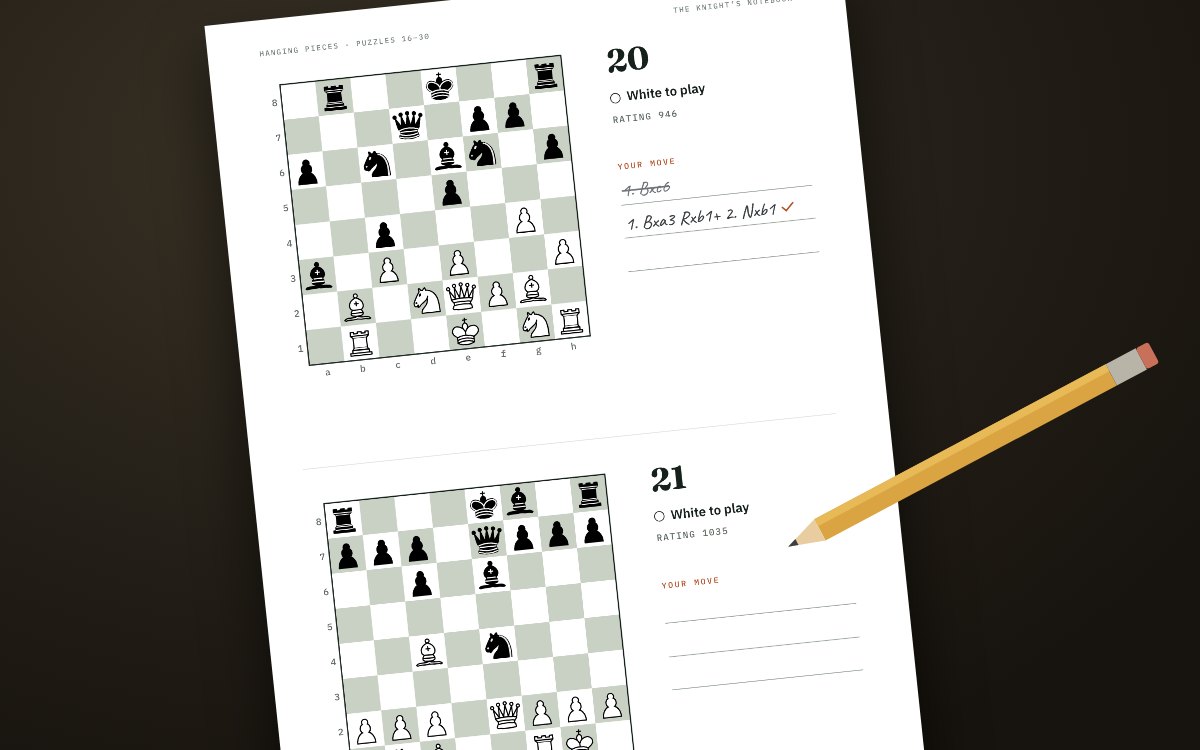
Most puzzle apps tell you after each move whether it was right. So you try the move that looks likely, and the app does the checking. On paper, nothing tells you anything until you turn to the solutions: you work out the whole line first, as you have to in a game.
In a puzzle app
- Every move is marked right or wrong at once.
- A wrong try costs one click, so you try.
- The app plays the reply for you.
On paper
- Nothing is marked until you turn to the solutions.
- You write the whole line first, so you work it out.
- You find the reply yourself, as in a game.
That is the habit a game asks for: see the whole line, then play.
Fifteen puzzles a theme, from easy to hard.
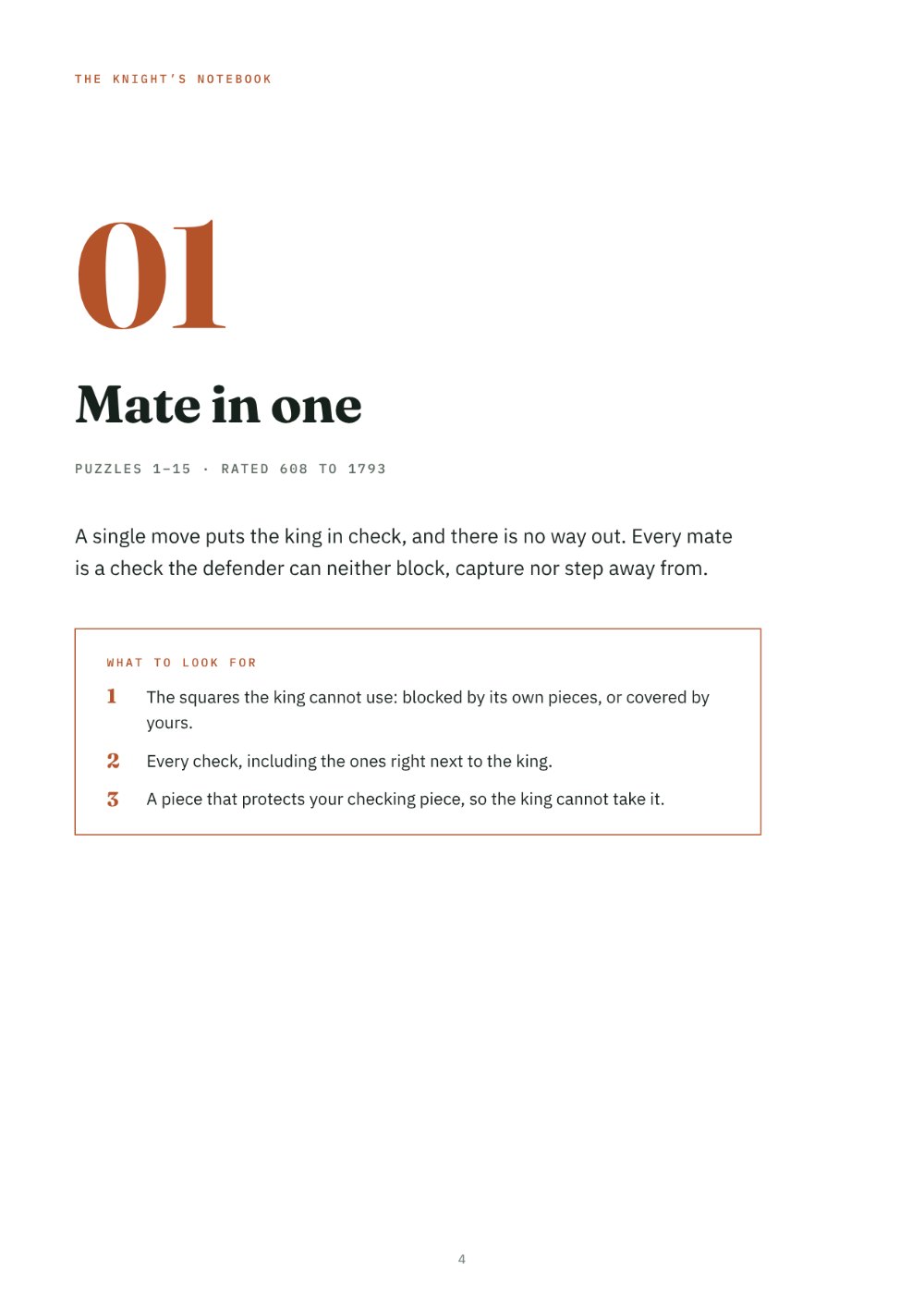
Each theme opens with a lesson: three signals to spot and two worked examples. Then fifteen puzzles, from easy to hard, with the rating beside each diagram.
- 01Mate in oneFind the check the king cannot escape, in a single move.608–1793
- 02Hanging piecesA piece that is not defended, or not enough, can simply be taken.593–1792
- 03ForksOne piece attacks two targets at once, and only one can be saved.604–1799
- 04PinsA piece cannot move without exposing a more valuable one behind it.659–1798
- 05SkewersThe valuable piece stands in front; when it steps aside, the one behind falls.596–1809
- 06Discovered attacksOne piece moves out of the way and uncovers an attack behind it.615–1808
- 07Back-rank matesA king shut in by its own pawns, and a rook or queen on the last rank.605–1798
- 08Mate in twoA forcing first move, often a check or a sacrifice, then mate.598–1801
- 09PromotionClear the pawn's way to the last rank, or promote at the right moment.647–1800
- 10DeflectionForce a defender away from its job, and what it guarded falls.603–1807
A lesson, fifteen puzzles, every answer explained.
A lesson for each theme
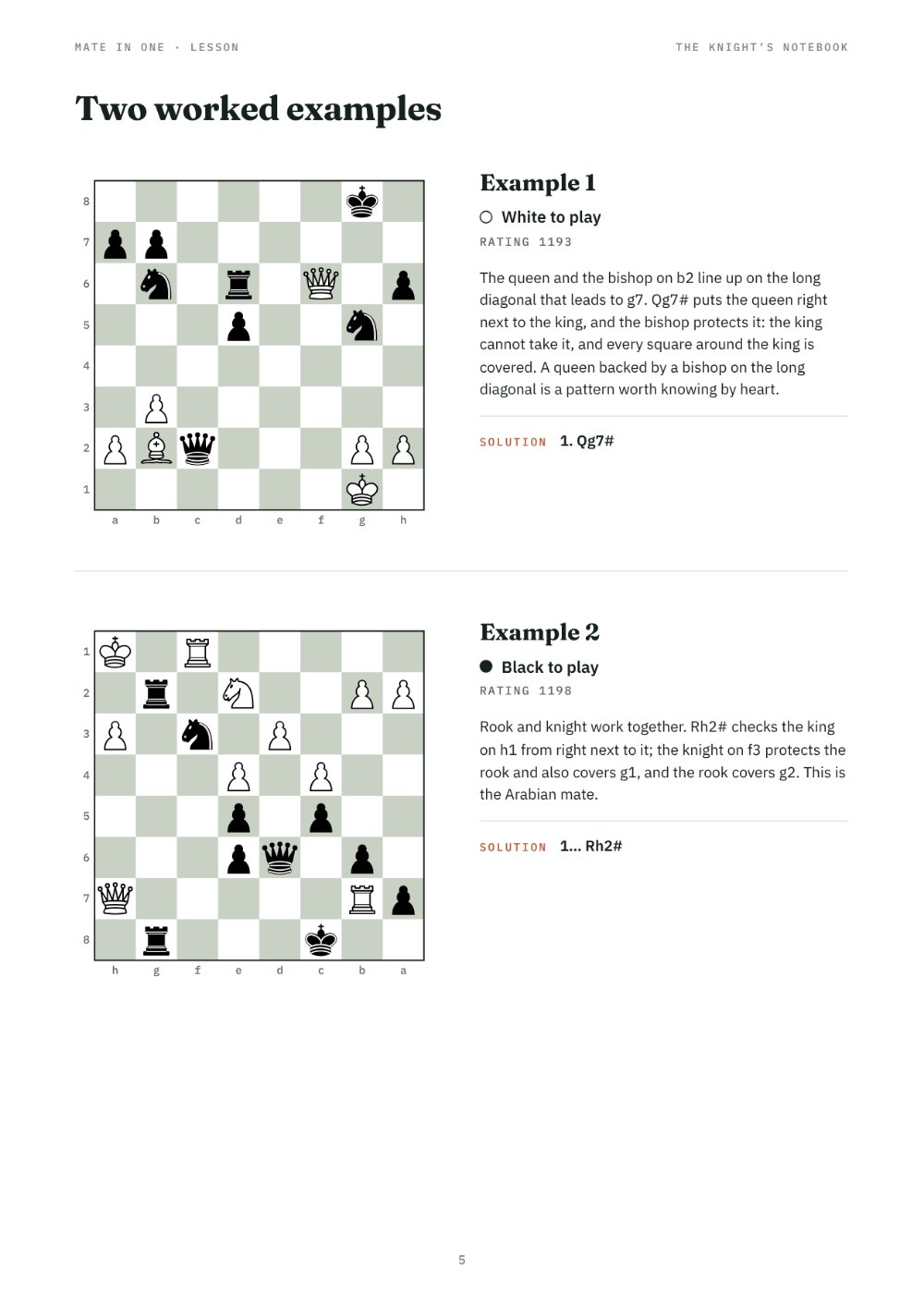
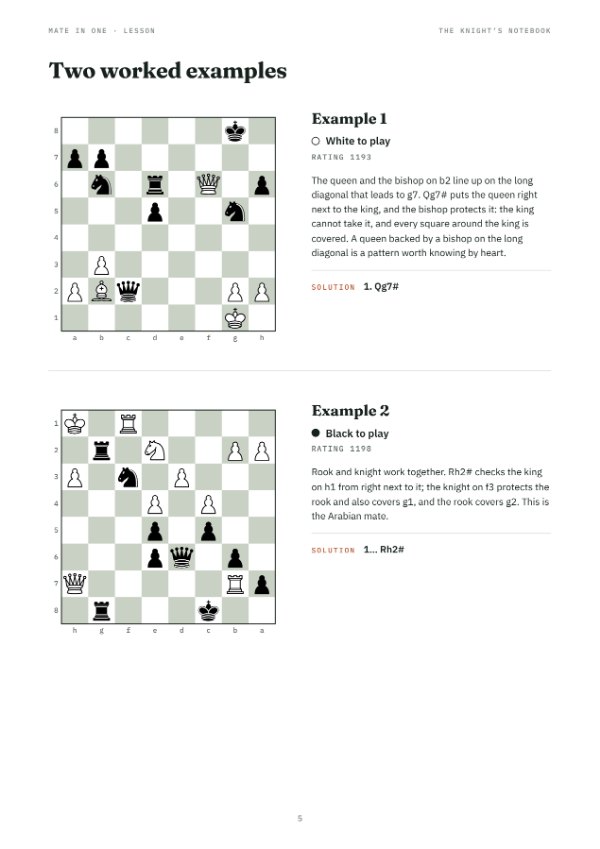
Before the puzzles, two pages on what to look for: three signals to spot, then two worked examples, each with its board, its solution and why it works.
Every solution explained
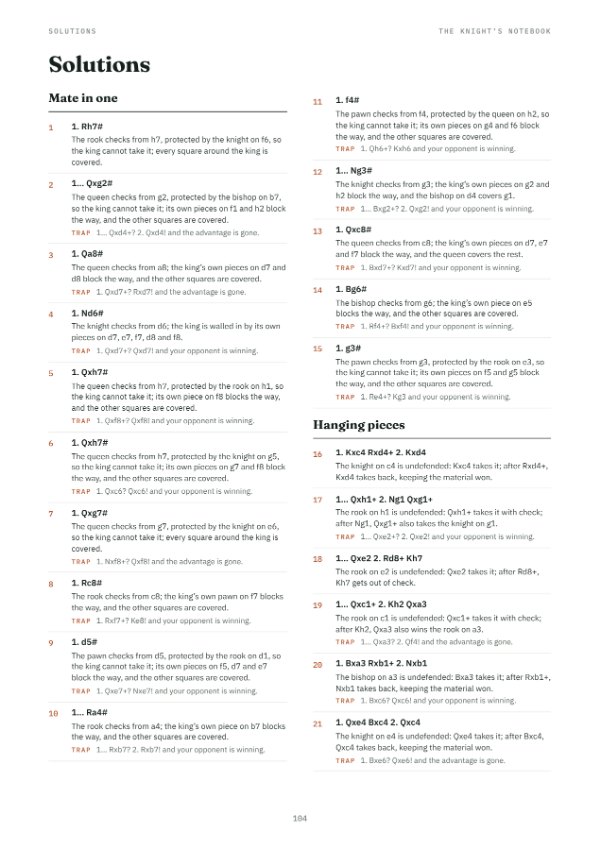
Each solution gives the whole line and, in a sentence, why it works. 116 of them also show the tempting move that fails, and the reply that refutes it.
Rated by players, checked by Stockfish
The puzzles come from the Lichess puzzle database, where a rating reflects how players actually did; each has been tried at least 800 times, most more than 2,000. Every move was checked with Stockfish.
111 pages, ready to print.
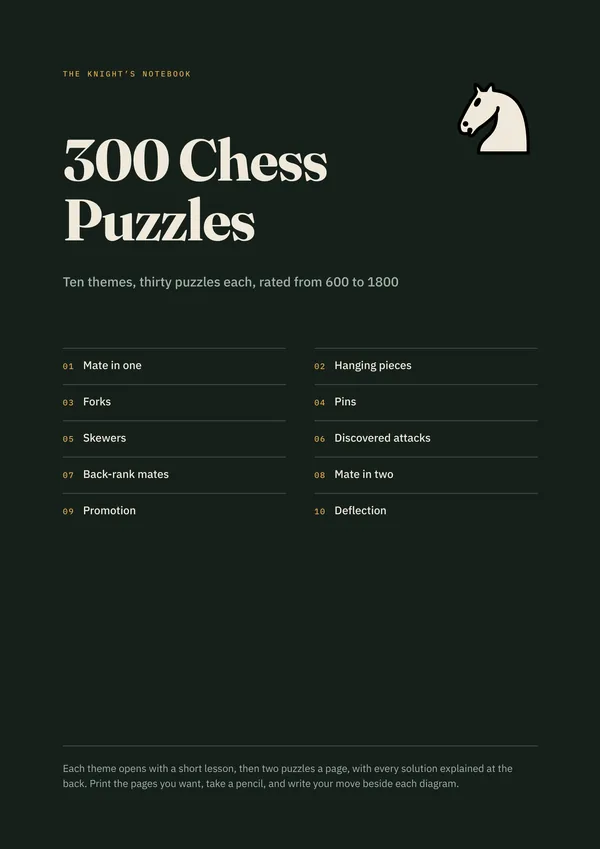
The same book, with 300 puzzles.
300 puzzles
The same ten themes and the same lessons, with thirty puzzles a theme instead of fifteen. No puzzle is in both books: you can start with the 150, then go on with the 300.
Your questions, answered.
Is it right for my level?
Yes, from about 600 to 1800 Elo. Each theme starts gently and builds up: if you know how the pieces move, you will make progress from the first pages, and if you play at a club, the last puzzles of each theme will give you a real fight.
What does each lesson give me?
What you need to spot the pattern in your own games. Each theme opens with two pages: the three signals that announce it, then two worked examples, each with its board and explanation. You then take on the fifteen puzzles knowing exactly what to look for.
How are the solutions explained?
Every one, in full and in plain words: the whole line, then a sentence on why it works (the pinned piece, the squares covered around the king, the defender lured away). For 116 of the 150 puzzles you also see the tempting move that fails and the reply that refutes it: that is often where you learn the most.
Why paper?
Because that is where you really improve. As in a game, nothing tells you whether your move is right: you calculate the whole line, write it down, then check. That is exactly the habit the book trains. And if you prefer, it works well on a tablet or a computer too.
Can I print it more than once?
As often as you like: the whole book or just today’s pages, for you or the whole family. The pages are A4, ready to print; on US Letter paper, choose “Fit to page”.
When will I get it?
Right away. The moment you pay, an email brings you a download button, usually within a few minutes, and the link keeps working whenever you want to download it again. Anything wrong? Check your spam folder or write to us at hello@knightsnotebook.com: we will send it again.
Is payment secure?
Yes. You pay by card or Apple Pay through Stripe, one of the most widely used payment platforms in the world, and other options may be offered depending on your country. We never see your card details. It is a single payment, with no subscription.
How is it different from the monthly notebook?
This book drills tactics in depth: 150 puzzles sorted by theme, each theme with its lesson, to keep and come back to whenever you like. The monthly notebook is your regular training: every month, sixty new positions at your level, across all the themes. The two go together.
Are these puzzles in 300 Chess Puzzles?
No: the 150 puzzles of this book are its own. None of them is in 300 Chess Puzzles, The 30-Day Chess Challenge or the monthly notebook, so you can go on to any of them without ever meeting a puzzle you have already solved. The lessons that open each theme are the same as in 300 Chess Puzzles.
Where do the puzzles come from?
From real games. They come from the Lichess puzzle database and have been tried by many players, so their difficulty is measured, not guessed. We picked them, sorted them by theme and difficulty, and checked every solution with the Stockfish engine.
150 puzzles. One pencil.
$10.90, paid once. Instant delivery: the PDF is emailed the moment you pay.
Get the PDF · $10.90Finished the book? Keep going with the monthly notebook: sixty new positions at your level, every month.